What Nobody Tells You About Renting Commercial Real Estate
If you know anything about me and my journey in the last few years, you know that I started a business, leased a commercial real estate space for a coffee shop, built it out, never got to open it, and after paying for it for 12 months, I decided to close up shop. Not many people start a business assessing the threats of dissolved partnerships, contract obligations, or dealing with difficult people that are directly tied to your business. And I’ll be honest, I was one of those people. I, like many at the starting line, was wide-eyed with possibilities, with the romanticism of a coffee shop, and with the dopamine hit of getting tagged on Instagram by people gushing over your offerings.
Una Más brick and mortar closure announcement, October 2025. The finished space after a full buildout that never got to open.
But the reality behind a business is often a more boring one, a more complex one, and one full of managing and dealing with people. And as far as people go, there’s always going to be conflict. It’s natural, we're humans with our own perspectives, baggage, and blind spots. Most of what we do is subjective; however, there are some mechanisms that govern business relationships. And one specifically we don’t often talk about: contracts in commercial real estate. So today, let’s chat about the importance of knowing your rights and how that’s tied directly to your lease contract. Because I have learned some hard lessons in the last year and a half, and I hope that through what I’m about to share, you can avoid those mistakes and protect yourself. So without further ado, here are the 10 lessons I learned about renting commercial real estate for a year for my coffee business, and the 6 months that followed after that:
1. A sale is a sale
In the modern world of social media posts and engagement, a lot of us have learned how to sell, it’s almost become intrinsic. How to sell a brand, an idea, ourselves, a space. And most landlords are going to sell you the moon with their space. The benefits of location, of the setup, of the price. So when you’re envisioning the space transformed into your coffee shop, it’s hard not to get carried away by their promises or your vision. And yes, it’s exciting, it should be. But take it at face value: the landlord is trying to sell you a space. If you sign with them, you become the person who pays for their space and is bound by the contract that they write out. So think it through with a sober mind and ask yourself a few things:
Can you grow in the space? This goes both for the physical space and its capacity, but also if your business evolves. For example, if you decide to add food to your coffee shop, will it be allowed there? If you need more space, how long are you locked into that space before you can grow in a bigger space?
Are you willing to leave money behind if you leave the space in a year, five years? It’s common for commercial real estate leases to say that improvements are landlord-owned. So if you outfit a space as a kitchen by adding FRP to the walls, or you install a new AC system, or a hood system, that stuff belongs to the landlord after you leave. In my case, anything that would damage the walls if I took it down didn’t belong to me anymore once it was installed - so the FRP in the kitchen, the plumbing I added, the paint, and the new electricity I added to the space - all of that stayed behind. I never saw a penny of the money I paid for it, and I knew that before I even signed the lease, so I was methodical about how I built it out with the other stuff: I never bolted down the bar and was able to sell it, as well as a banquette we built and other custom stuff we did in there.
If something goes wrong, are you allowed to leave? Life happens. Sometimes it’s a permit issue. Sometimes it’s health issues. Maybe you ran out of money. Whatever it may be, you have to know that there’s a way out for you and that you’re not paying rent for four more years without being able to operate out of there (I know this has happened to other coffee shops - and yes, commercial real estate leases are notoriously long, five years or more). There would be a fee if you negotiate this into the lease, but you have to make sure this is included in it and that it’s not going to ruin you.
2. Know your rights
Look up your state laws ahead of time regarding commercial real estate. It may seem overkill, but knowledge is power, and you don’t know what you don’t know. If something comes up and it feels off, look it up. In my case, the landlord installed cameras inside my space without my consent. I asked him to take them down, and he refused. Because of the build-out we were doing, he had to take them down, but still mentioned he would put them up again because he was protecting his investment. He didn’t end up doing it, but I was ready with specific law to reference that I had grounds to object and refuse.
In another instance, and this happened minutes after signing the lease, he announced he would be using the closet in our space to store his stuff. I immediately said no, and just like the camera situation, he did end up dropping it. But he dropped it only after several attempts to get him to empty the space and us having to do it ourselves. So, know - the space you rent essentially belongs to you during the time of the lease. You may not be free to do whatever you want in there necessarily, but that depends on the lease. If a landlord insists on still using a part of your space, use the contract to outline it and make it clear, and you should get a lower rate for that as well. So familiarize yourself with your contract before signing it, and make sure it’s specific and it outlines your space, your rights, and what you can do in it.
3. Know your contract
This is a big one, and it requires its own section. Read it before signing it. Read it several times. Ask people who have done this to read it for you. If you have access to a lawyer, ask them to read it for you. And if you have absolutely no one, run it through AI and ask it to explain it to you, with the caveat that AI can make mistakes, but at least it can point you in a general direction. Contracts are not written in plain language, and sometimes little phrases have a different meaning than what it seems. A contract written by a landlord is first and foremost written to protect them and their space. They are not written for your benefit. However, they can also protect you, but most likely you’ll have to ask for those clauses to be included. A real example from my experience:
For the first draft of the contract for my brick-and-mortar space, I basically took a pen and marked it everywhere and then wrote an email with everything I needed changed there. The biggest red flag: a non-compete clause. Now, I had worked in a firm that did startup consulting, and I sat next to a business lawyer for years. This had come up in conversation, so I remembered that in the state of Florida, non-competes are not necessarily enforceable since it’s an at-will state. But if you sign a contract agreeing to this, you could be bound by the contract and could still waste time and money fighting it. So I knew that there was no way I would ever sign one. If I had, I would have been limited to what I could do after I left the space, and my ex-business partner would’ve also been affected (you’re welcome, bud). The landlord fought back and limited the initial, very broad non-compete to just within the city of Tampa boundaries, but I still said no. He reasoned that he was protecting his investment, so I flipped it on him and said if he wanted me to sign the non-compete, I would consider it, if he also signed one so that I could protect my investment too. He dropped it.
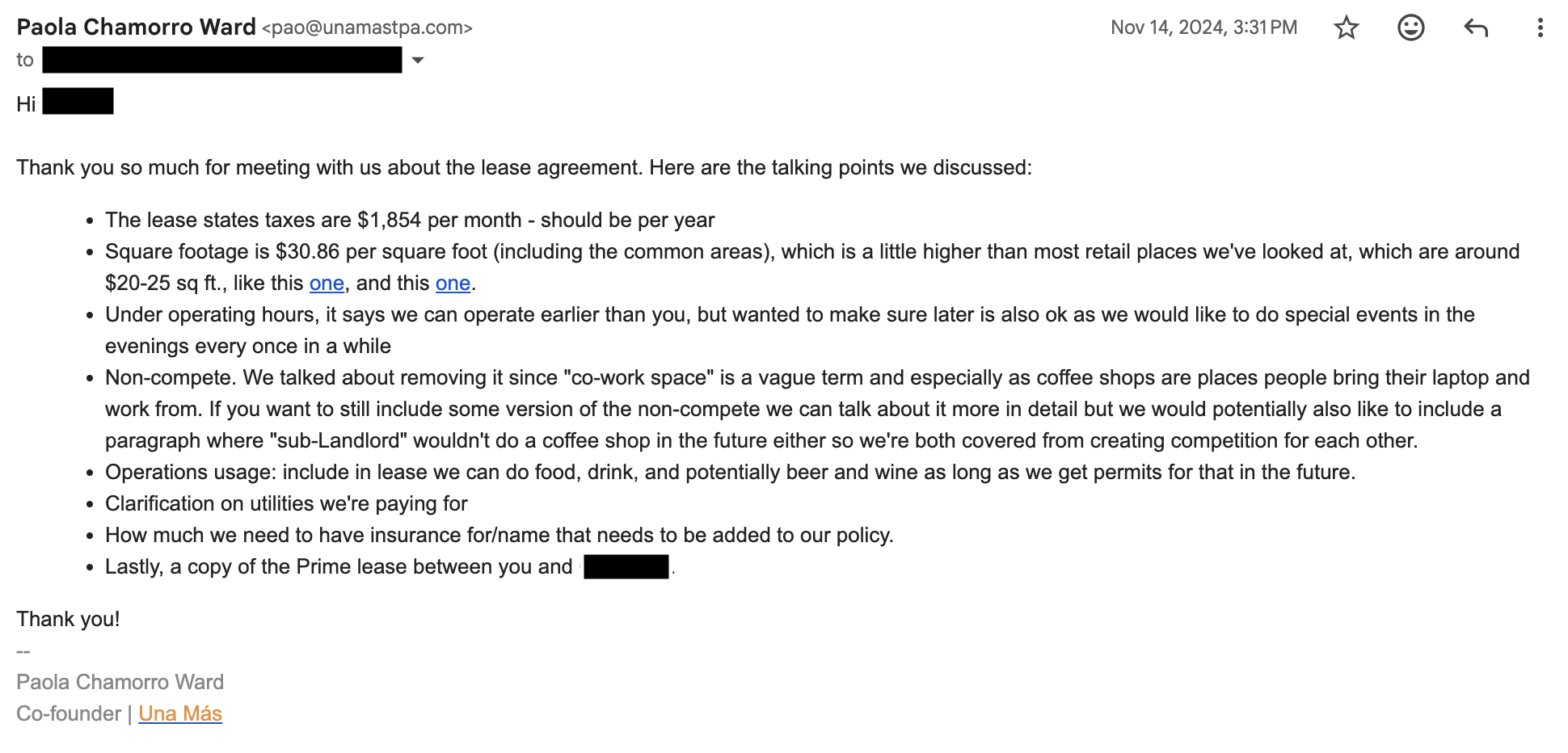
I wasn't a real estate expert. I was a barista who learned to ask questions — and one of them caught a lease that listed taxes as $1,854 per month when they were supposed to be per year. I don't think it was intentional, but that's the thing about a lease: once you sign, an honest mistake becomes your $20k problem. This is everything I found during my commercial lease negotiation, and what I'd tell anyone about to sign one. But I missed a big one (see #4).
Negotiation is a back and forth. Don't let anyone pressure you into signing before you've had a few conversations — asking questions, pushing on price, clarifying terms. You get what you need first, then you move forward.
4. Rent abatement
This is one is huge, and one that I fully missed in my excitement for the space. You can negotiate rent abatement: a limited time that you get rent-free in order to build out or accommodate the space to your business needs. This is common in real estate leases. It wasn’t presented to us, and I just somehow forgot to bring it up, so I paid rent for this space from day 1, even though the space wasn’t even empty or clean. So, before you sign, make sure to bring up rent abatement and negotiate something, anything, because it truly helps. Not only did we pay from day 1, but the space wasn’t ready for us, and we had to wait for the landlord’s electricians to be back in town to do anything because they had asked us to only go through him for anything related to the electricity. Talk about a lose-lose situation.
A day in the life of building out a commercial space for a coffee shop in Tampa, Florida — March 2025. Documenting every improvement, every decision, and every delay.
5. Know what the lease says about how you run your business
This comes from experience with a couple of commercial spots. Contracts can be as loose or as specific as the person writing it wants them to be. In one instance, the contract required me to have everything approved in writing before doing anything at all: colors, design, placement, any furniture we’d bring in, our brand, etc. Not only did this feel stifling, but I knew it would create delays and a timeline I could not even count on, controlled by the person I had to pay rent to. Obviously, I never signed that lease.
This most recent one wasn’t that specific, so I did what I wanted with it, within the parameters he had given me: no drilling or messing with the floor, or removing any walls. However, this was a semi-shared space - I held the front part of the space with the main public entrance, and the landlord held the back part, with one private entrance to what became his wife’s studio. This arrangement became an issue as he wanted to dictate how I ran my business, and he felt he had the freedom to label stuff on our front window/door however he wanted (even though I paid for that entire space).
I had agreed to people being able to use that entrance; in theory, it benefited me to have everyone come through our shop, but it was more of a hassle than it was worth. And none of that was outlined in the contract.
His 24/7 access to our space is something I didn’t think about as an issue, but it became a pattern that added an extra layer when tension rose: a lack of boundaries that I couldn’t create or enforce, and a lack of respect for the space being mine.
The lack of privacy and boundaries proved more than an annoyance when the landlord and his wife would walk in during meetings with my ex-business partner, whom he became close with. This became especially loaded when we were going through a partnership dissolution (and remember, he had private access through the door in the back of the building), and when his wife would come into our space when we weren’t there and take videos of it. We knew because we had our own cameras.
The ongoing tension made it a miserable situation. But I wasn't going to abandon a space I was paying for. And I knew my rights.
6. Document everything
The day you receive the keys, take pictures of the condition of the space. Everything that stands out, that’s damaged, that looks off. And do a full walk-through video as well that same day. Then repeat the process on your very last day. This could come in handy one day if there are disagreements on the way you left the space or if your landlord imposes a claim on your deposit. Also, keep track of improvements you made, keep receipts, every approval from the landlord, and follow my dad’s advice: if it’s not in writing, it didn’t happen. Even text conversations can be proof of knowledge, compliance, and approval.
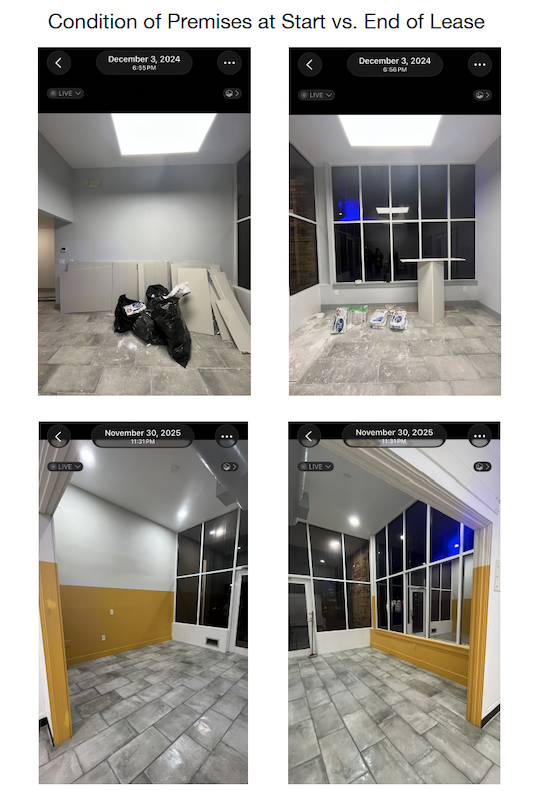
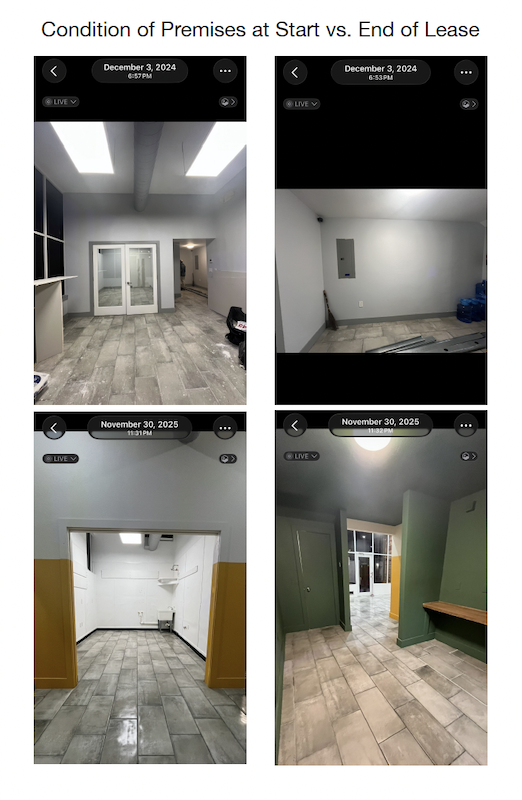
We technically started paying rent on December 1. The top photos are from December 3 — the space hadn't even been emptied or cleaned for us. The bottom row is the same space when we handed it back a year later. Document everything on day one: date-stamped photos of the condition you received the space in will protect you at move-out, and there's no arguing with a timestamp.
7. Do your due diligence
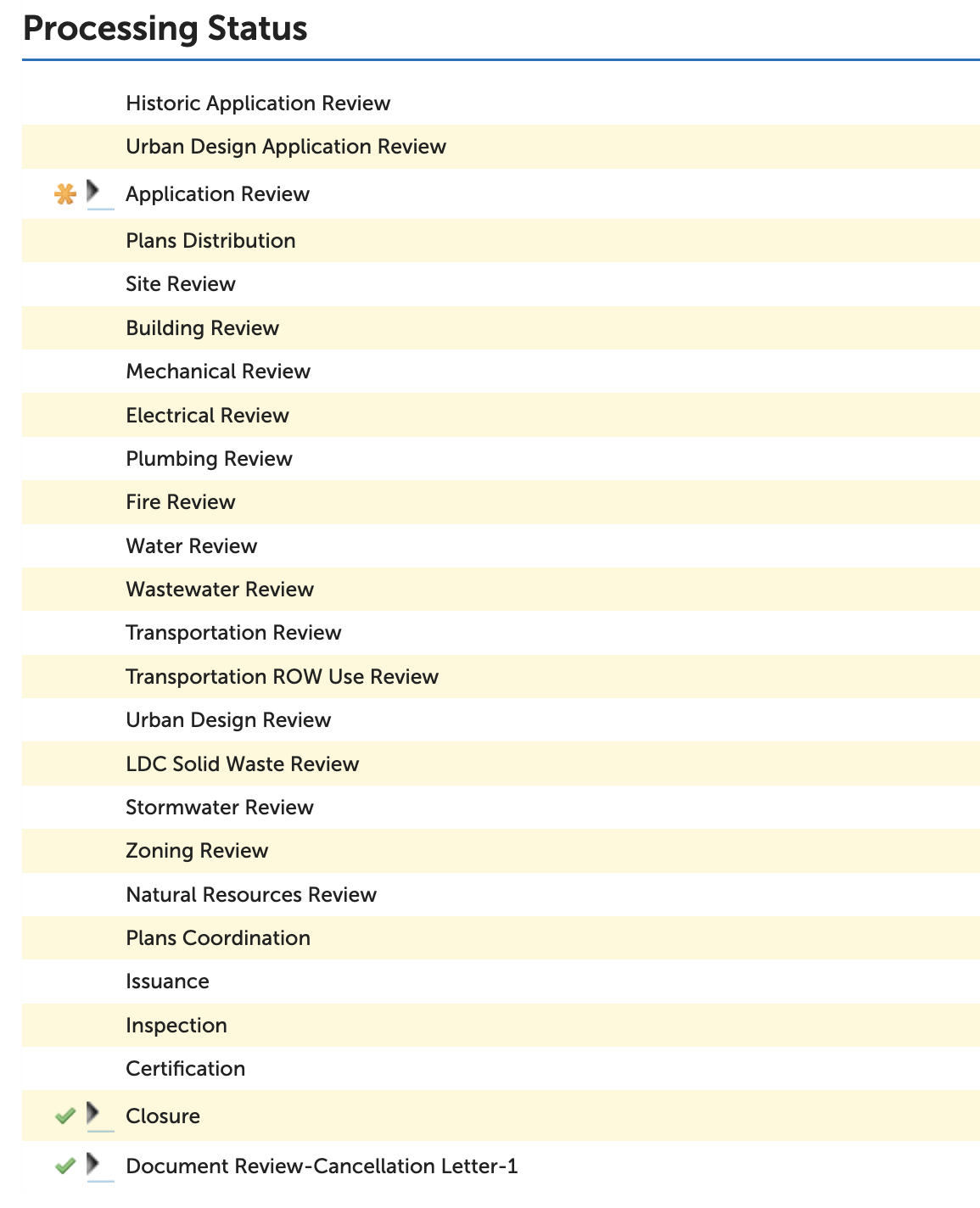
Depending on the state you are in, there may be different requirements in place to open a coffee shop. Maybe even more so if your shop is also preparing food, and more depending on the kind of food it sells. It’s a lot to figure out but worth the in-depth research before you sign. In Florida, the agencies that oversee this are the Department of Agriculture and the Department of Business & Professional Regulation (Hotel & Restaurants). Because we made breakfast food, we had to go through DBPR, and because the space had been previously an office, we had to present a change of use through them and show plans on how the kitchen had been adapted to be food safe. On the city side, I personally called them directly before signing the lease to make sure the space was zoned correctly, which it was. We also had to have the Fire Marshall come and check out the space and approve it. After months of build-out, we were having what we thought would be our last inspection before opening with DBPR. Turns out, the city also requires a change of use, and without it, the inspector would not pass us. The city’s requirements for doing the change of use included water tests, potentially a new water meter, engineer drawings, parking studies, and a lot more than we ever expected or were told in all our previous conversations.
The landlord had told us the space was ready for a coffee shop, it wasn’t. In my opinion, this could be interpreted as misrepresentation, and I’ve known of other restaurants that have gotten out of leases through this, but we were too deep at this point, so I called the city to see why I hadn’t been told about this change of use requirement. Their answer: “You talked to zoning; this is a permitting issue.” And that permitting issue was anything but simple. Below is what our actual processing status looked like, and why it was never going to be a quick fix.
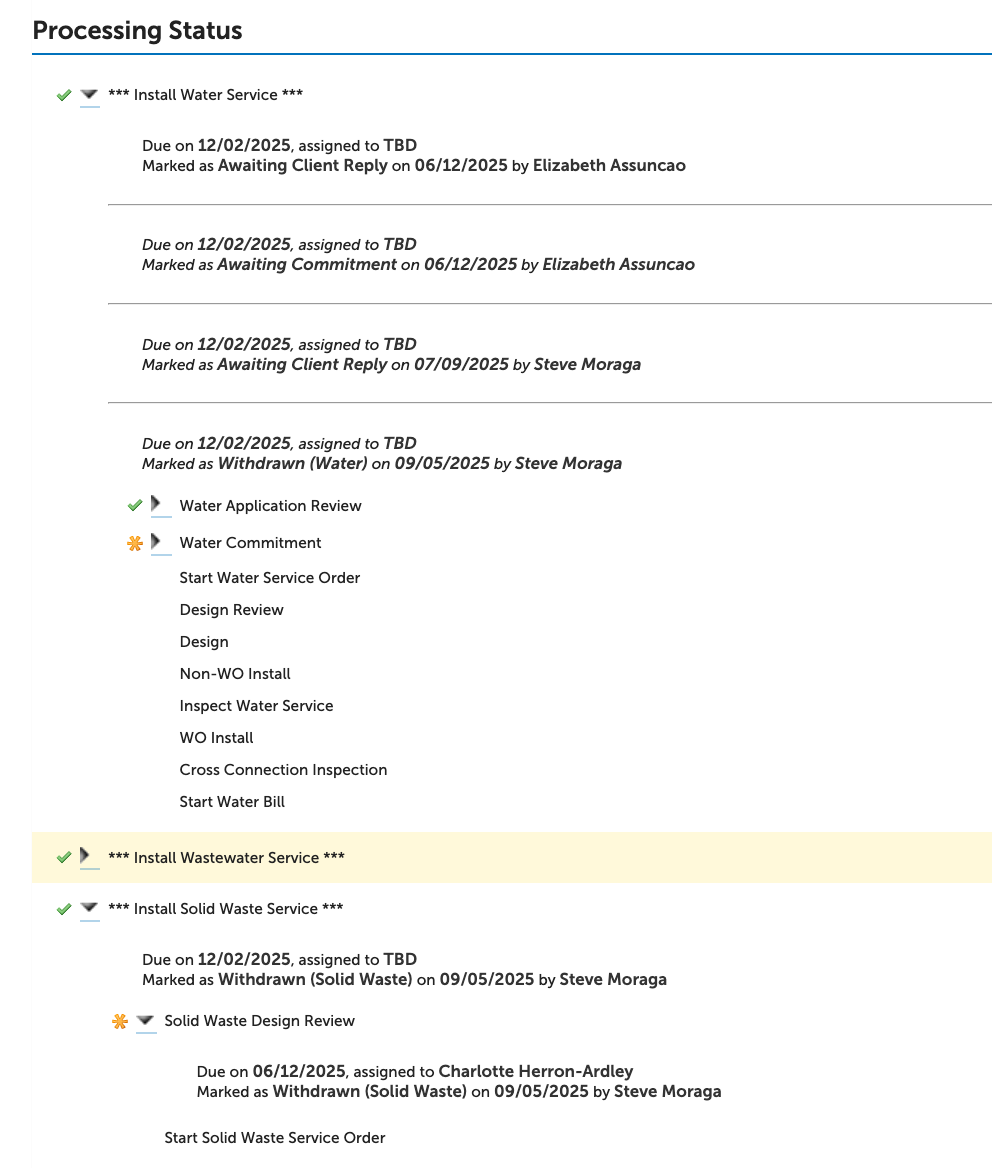
The lesson: if a space has never been a food and beverage space before and gotten the approval for a change of use, do not sign. Unless you have time, money, and really love the space. Thankfully, I had only signed a one-year lease with the option of four more. The clause that allowed me to get out of the lease would’ve cost me 2 months’ worth of rent, and by this point, I only had 4 left, and my business was operating as a pop-up, so I couldn’t focus on leaving the space quite yet. I decided to cut my losses, finish out the entirety of my lease, and not re-sign. Even if the space you’re looking at had already been a food and beverage concept before, the city could still require the change of use if it was never done before, so look into it and don’t let permitting slow you down more than it normally would - learn from my experience.
8. Subleases add a layer
Something worth knowing before you sign: if your lease is technically a sublease — meaning your landlord leases from someone else and then leases to you — you are not the first person in that chain. And that matters. When permitting issues arose for us, every conversation, every document request, every delay had an extra stop along the way. The city asked for drawings of the original space, and getting anything done required going through my landlord, who then had to go to his. It made everything slower and more frustrating than it needed to be, even though they both actually did help to get what was needed. But had we moved forward with the full permitting process, I have no doubt the tension would've continued to rise as more requirements and changes to the building, like a new water meter, would’ve taken place. Know the chain before you sign.
9. Know your options
At the end of the lease, I emptied and cleaned the space and returned the keys. And yet, after 12 months of paying rent, never being able to open the coffee shop, and improving the space, the landlord withheld my deposit and didn't follow the procedure required by the lease. But I knew the contract like the back of my hand. I had read it several times at the start, several times when issues started coming up, and several times when I was getting the space ready to return it. So I researched how to get my case in front of the small claims court in Florida. I kept receipts, pictures, and a clear timeline of my time there and what the lease required, and I won.
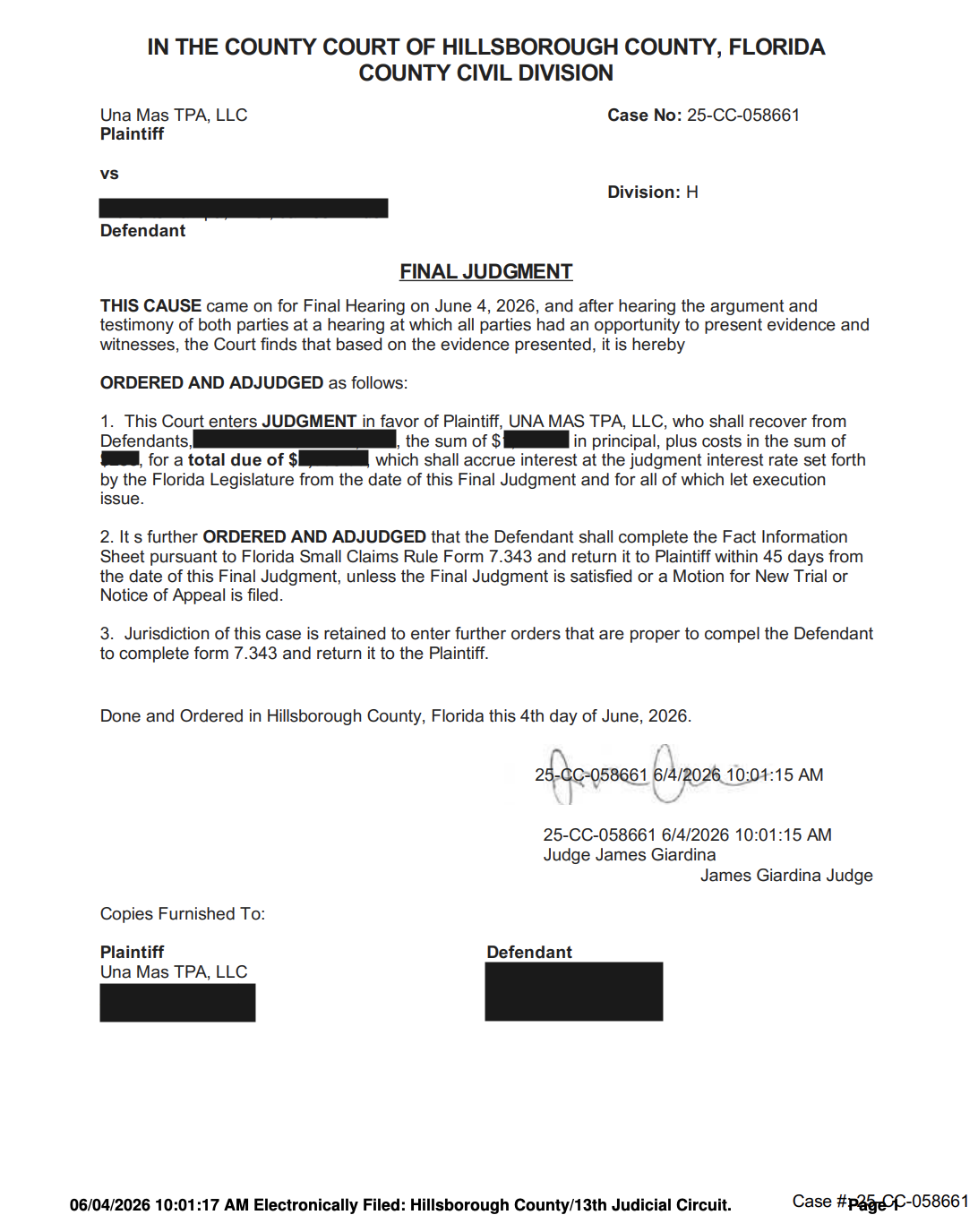
Small Claims Court Final Judgment — Commercial Lease Deposit:
The court ultimately agreed that the lease controlled the outcome, and the judgment was paid. This mattered to me, not because it erased what the year cost me (in both money and energy), but because it confirmed something I kept having to remind myself: documentation, contracts, and following the process matter.
I had never sued a person in my life, and never thought I would, but not only did I feel like I had to do it on principle, but the actual lease also reminded me that I had rights, and one of them was the right to recover my deposit if certain requirements weren’t met by the landlord. So, know that small claims court is more accessible than you think. Sure, it feels intimidating if you’ve never done it before, but if you’re organized and know the lease, then your job is just to follow the steps and trust that the system acts in accordance with the lease.
10. Know when to stop
After putting together my case, organizing evidence, and talking to trusted friends and business advisors, I have what looks like a much bigger case with other stuff I alluded to regarding how things were handled. However, I chose not to pursue everything I could because at the end of the day, my bandwidth and moving forward mattered more to me. I asked for accountability, I stood up for myself, and I won in the deposit case, and that’s enough for me to close down this chapter. My energy is more valuable when invested in my business and not when it’s misplaced into a space that wasn’t meant for me, around people that also didn’t exude peace or creativity.


So that's the real answer to why we closed: not because the concept failed — the pop-up proved it worked. This space wasn't working in many ways, permitting was an uphill battle, and I wasn't willing to commit four more years, an unknown amount of time, and more money just to get it right with the city before we could even open the doors.
Was it a tough year and a half? Incredibly. Did I learn a lot? More than I hoped to learn. But now I'm on the other side of it, and I hope this saves you from learning it the hard way. Would I do it again? Yes, but very differently.
If you’re navigating something similar, share your horror stories below in the comments so we can all learn together. And if you want a sounding board, let’s chat. I sometimes work one-on-one with people who are ready to invest in their businesses and want to avoid costly mistakes. I also have some guides in case you'd rather go the self-guided route. Otherwise, we can connect on Insta, because whether we work together or not, I’d love to cheer you and your venture on!
