How to dissolve a business partnership
I walked in expecting to lose the company, and walked out keeping it. That didn't happen by luck, or even planning. It happened because I did the actual work behind a real valuation, because I was patient and didn't rush the process, and because I had good people advising me along the way. Those are the three things I'd tell anyone in this position to prioritize - as tough as it is to go through this process, do not rush it.
No one goes into a partnership thinking it's not going to work out, but unfortunately it doesn't always, and knowing how to dissolve a partnership is something worth knowing before you agree to share your business, decision power, money, and liability with another person.
I went through this firsthand last year. And when a friend was recently going through something similar, I was inspired to write this. Because I fully believe knowledge is power, because I process through writing, and because I also think it's worth talking about the difficult part of business ownership. Not to dissuade anyone from going into business, but so they're better equipped to make decisions regarding their business.
The background
I've been working towards opening a coffee shop for the better part of the last 15—18 years: I actually came back to the U.S. as a 20-year-old specifically to learn how to build this: as a woman and an immigrant starting from zero. Which maybe explains why I've never been able to treat 'the plan' casually. I went to USF for entrepreneurship, and my first job out of college was a startup consulting firm, and I took that job with the specific reason to learn how start and manage a business. The last 10 years I have spent working in the coffee industry, from barista to GM, to starting a cold brew business, starting a coffee cart, and then a breakfast and coffee pop-up, and finally a brick-and-mortar that never opened its doors. I have been so intentional about this. And I had one rule from day one for myself: I would never partner with anyone or take an investor. And then I broke my own rule regarding partnering. Why? Because it was with someone I had worked with for years, I trusted them, and we made a great team. Still, the mistake is fully on me.
See, when you partner with someone in a business, you enter a relationship that in many aspects, may mirror marriage: you share a bank account, you're liable together, you have to make decisions together. And if you don't have the same vision, or you change your mind in the process, getting out of the partnership also mirrors a divorce. It's painful, long, and socially awkward (especially for the community around the partners).
So how do you dissolve a partnership? A lot of it depends on how you got into it, what you own, and how you structured it. Mine was 50/50, and we each had put in $5,000 to start the business. We each had identified different things we'd be in charge of (roles mostly), and by the point we had decided to part ways, we had been a business for about a year and a half.
Disclaimer: This isn't legal or financial advice; partnership laws, operating agreements, debt and ownership structures vary. This is simply the process I went through and what I learned from it. Here are the steps I took:
Have the Conversation
In my case, I asked for a meeting with him and his girlfriend, with myself and my husband. When we first started the business, the four of us met, and even though just two of us were officially on the business' papers and were operating it, we had agreed that we couldn't do it without our life partners. So it made sense that it would happen here too.
The conversation should be direct. I said something along the lines of "we're not seeing eye to eye on a lot, and that's ok, but I don't think we should be leading a team this way, much less commit to another four years at the brick-and-mortar we had built out." A place that I absolutely didn't want to stay in, and he did, at this point. I also talked about being burned out, which was 100% true. Then I laid out the options:
a. He could keep the business (assets, brand, etc.) and buy my half
b. He could keep the business and partner with someone else who could buy my half
c. We could liquidate the business, and we potentially would have to both put money to cover debt (loans, remaining lease contract, financed equipment, etc).
What was the price of buying me out? We didn't know yet, and it would take some time to figure it out, but that's what this process was for.
Inventory
I got to work and did a full inventory of every single piece of equipment we had in hand, how much it cost us, and how much we could sell it for. Most of the equipment had a resale price of 70- 90%, so I did the average and put everything down for 85% resale price. Again, this was an average, we just needed an idea so we could arrive at a starting point for our finances.
In addition, when I did the inventory, I was clear that anything I came with from my other business wasn't part of it - even though in retrospect, I should've at least charged something because we used that stuff for 2 years essentially for free: the coffee cart valued at $15,000 with all the systems included (pump, keg system, heater, etc), espresso bar utensils, the flattop we used to cook at pop-ups, etc. But I only counted the stuff we had acquired together as a business.
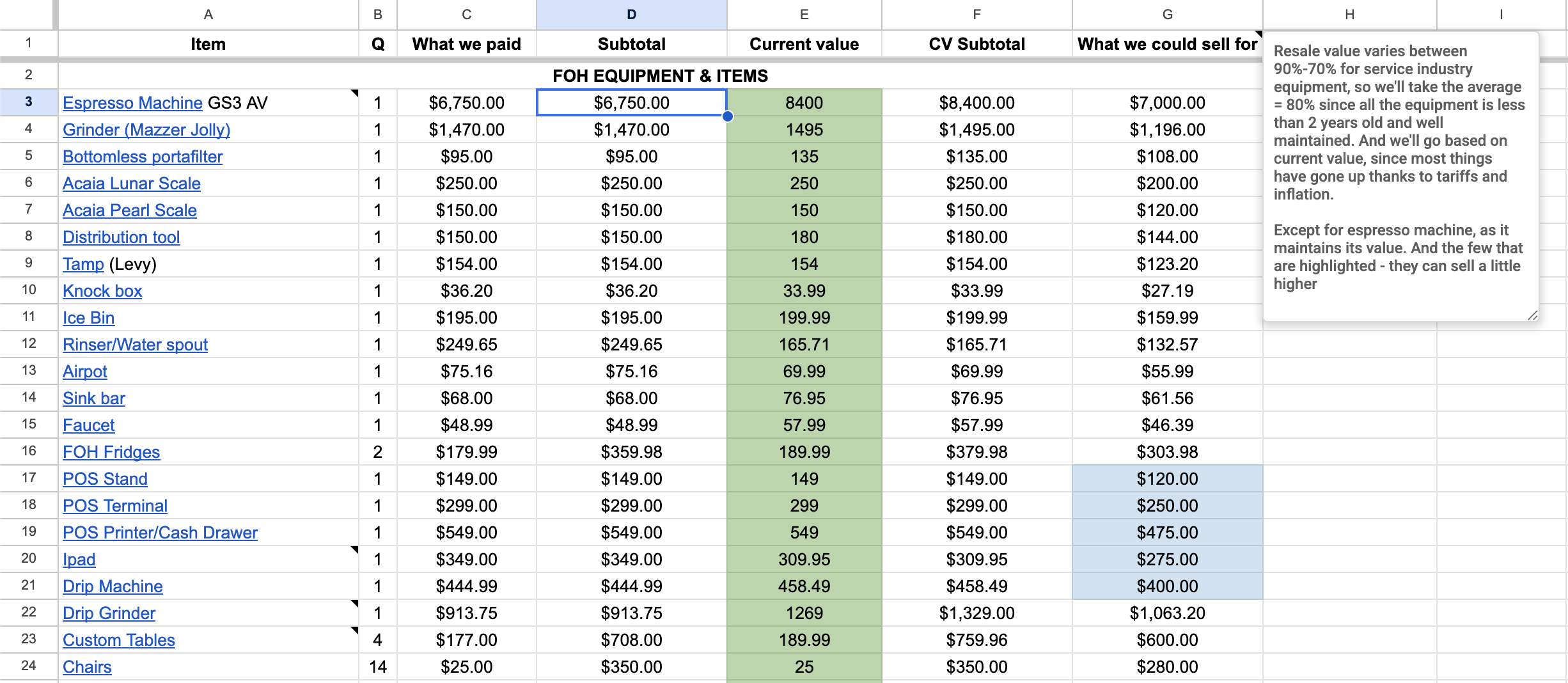
A section of the full equipment inventory: every item priced, valued, and resold at a real, documented rate.
P&Ls
One of the biggest mistakes I made managing the business was not focusing more heavily on our finances. Now, I knew where we stood financially every single day, however, I should've taken the time to do monthly financial statements, because that's when you truly see the health of your business, not just your cash flow. Profit & Loss statements are also key to get a valuation of the business, which would then give me a price for my half. So, I painstakingly tracked and entered all our financial data for the last 12 months. This was used to put together the necessary statements, with the help of my father-in-law, who is an accountant, used to be a CFO at a bank, and has gone through the sale of a business process a few times. What does doing P&L's take? Knowing your monthly sales, cost of goods sold, and fixed costs. So I combed through our bank account and entered the daily data into a spreadsheet.
Valuation
With the P&L's and inventory done, we could run projections. Now, projections to a new business can be potentially wishful thinking. However, for a business that had operated for a year and a half, we had hard data: weekly sales averages, a built-out brand and following, return customers, a group of members, and a brick-and-mortar ready to go, which is important when doing a business plan as your location dictates business exposure, ease of access to customers, etc.
In the last 12 months before this study our pop-up that only operated 4 hours a day for 4 days a week had brought in $123,000 in sales, including taxes and tips. This is no small feat for essentially only 16 hours a week of sales with only two breakfast entrees and coffee.
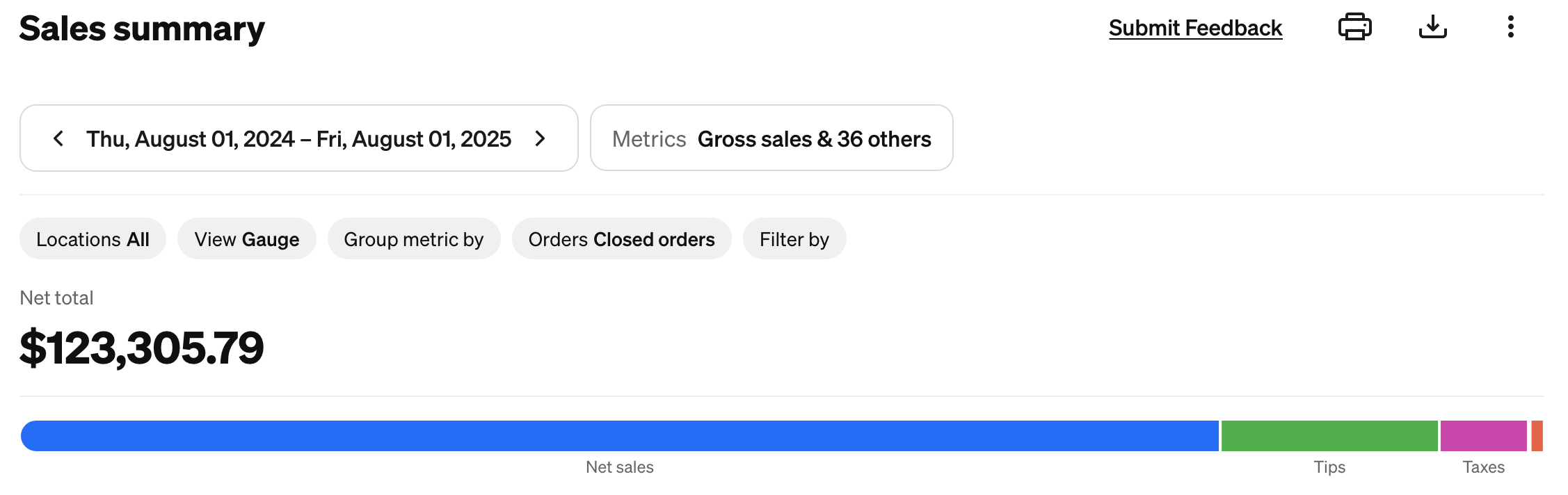
Sales summary pulled directly from our Square POS.
But also by this point, we
Had paid 7 months of rent already at the space we hadn't opened,
Were paying 10% of sales to the spot where we were doing our residency in, and
Had used almost all our income to build out the space.
So yes, we were bleeding money. But the data showed our income potential. The valuation took into account the last 12 months and projected the next 12 months: accounting for outstanding debt, increased days and hours of operation, more staff, higher taxes once we brought on employees, and what the brick-and-mortar was projected to generate once it opened with a full menu and at full capacity.
And based on the model we built, we arrived at a valuation of roughly $60,000.
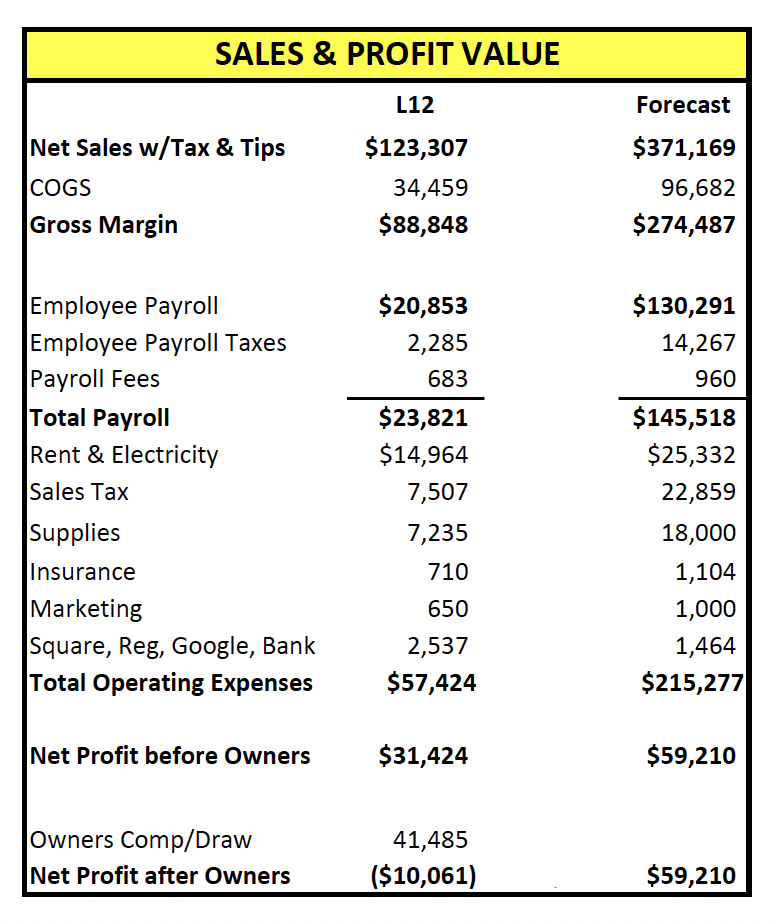
The valuation model: actual 12-month performance next to a full-capacity forecast, which is where the ~$60,000 number came from.
Negotiation
With a real valuation on the table and a 50/50 split, my asking price came out to $30,000.
I like negotiating. After graduating college, my boss at the startup firm gifted me Lean In by Sheryl Sandberg, which changed the way I looked at negotiating. And ever since, I've made a practice of it, from salary conversations to commercial lease terms. I always go in with an asking number and a walk-away minimum. I state my number, and then let the other side respond. I know never to do the work for the other party, as I always expect a counter. That's the whole point of the exercise.
But I also want to be clear about what that $30,000 was and wasn't based on: it came entirely from the P&Ls, the inventory, and real operating numbers. No sweat equity, no intangible "I built the brand" markup, nothing that couldn't be backed by a spreadsheet. I wanted a number that would hold up if anyone — a lawyer, an accountant, either of us — pulled it apart.
And I also want to note: the company's finances had always been fully shared: bank account, POS access, every spreadsheet (payroll, invoices, cost breakdowns), anything that affected the company, I shared it, even if I was the one who put it together. But the actual valuation work: the P&Ls, the valuation modeling was work that solely my father-in-law and I did together.
So I proposed we bring in a neutral third-party valuation firm — split the cost, hand over the financials, let them tell us both what the number should be. That offer wasn't taken. I also suggested he get his own valuation done independently, since I wanted the numbers to hold up regardless of who was checking them. Either way, everything I brought to the table was backed by real documents and statements, not guesswork.
Setting Boundaries
We were still operating as we negotiated, because the bills didn't stop. But once it became clear this was going to take longer and be harder than I had hoped, I set clear terms up front: if we couldn't agree on a buyout, we would have to liquidate — and if we did, every equipment sale had to be mutually agreed on, and any remaining debt (rent, loans) would be split evenly, since we were in a 50/50 partnership. I wanted the fallback plan locked in before things got messier, not after.
I also asked that we make all decisions on the business together: if we stopped pop-ups, if major menu changes were being made, or anything that affected the future of the company, etc. Even though I was the one leaving, my name was still on the paperwork, and I had as much responsibility and as much say in all things that were related to the business.
Getting to an Agreement
His offer was this: I walk away with no payout, and I personally cover the $8,000 the business owed my dad for build-out work. The other party keeps the business — debt, assets, brand, all of it.
Worth saying: my actual bottom line, the number I would've walked away at if it had gone the other way, was just my original $5,000 back plus the $8,000 owed to my dad. That was the floor. I wasn't trying to squeeze more out of a business I still believed in — I just wasn't going to leave my dad shortchanged for real work he'd done, and after doing all this work, I also knew my value and what I had contributed to this business, so the very least I would get out of it would be my initial investment.
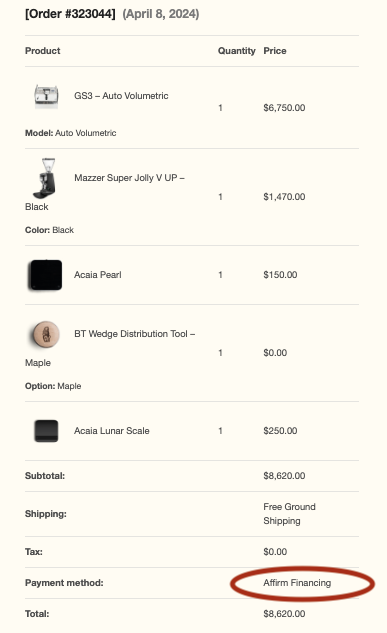
And that investment wasn't just the $5,000. We'd financed the espresso machine, grinder, and scales on my husband's credit. This was real, personal financial exposure on top of the cash we'd already put in.
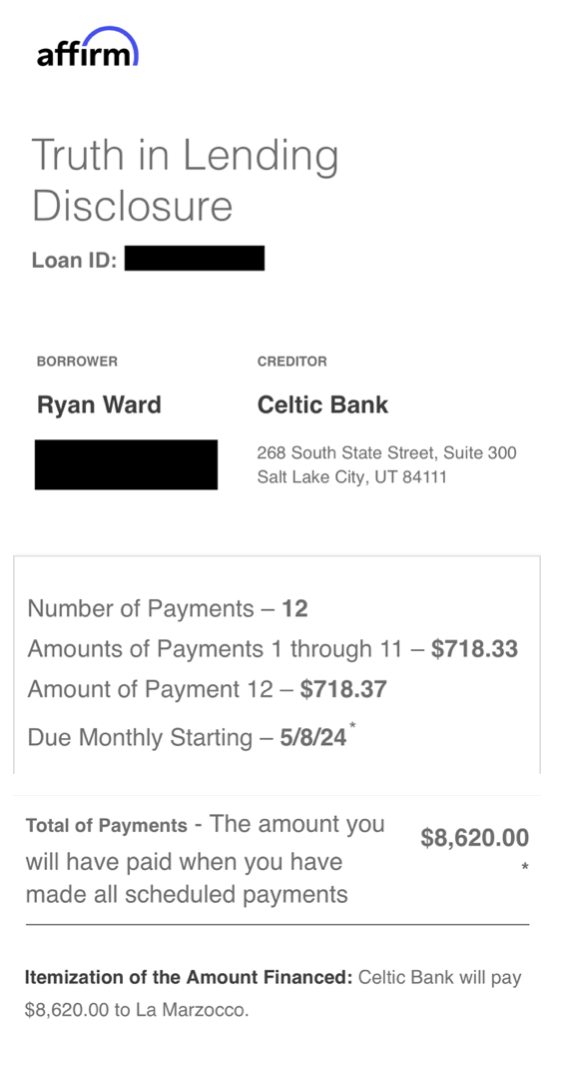
And for what it's worth, I would've been open to a payment plan for whatever the final number was too, it didn't have to be a lump sum. However, that was never something that got raised or negotiated as an option. By that point, I'd already done the inventory, the P&Ls, the valuation, the research about going to a third-party firm, all of it. I was done adding more work to an already exhausting process, and I wasn’t going to negotiate against myself.
I drew the line where I drew it and didn't accept the offer. Instead, I offered the same structure back, flipped: he walks away with none of the major debt, but also no assets, no brand, no business — and he covers what we owed his family (microloans that helped us when we needed the help). If that didn't work, we'd liquidate under the terms I'd already laid out.
He accepted.
That wasn't the outcome I walked into the conversation expecting. I went into this process assuming I'd be the one leaving, mainly because we were no longer aligned on vision or how to run the company and because my future plans had changed — not because I'd stopped believing in it. But I also wasn't willing to accept a deal that left my dad in the dust for real work he'd put into that space or invalidated my work.
And this wasn't just about a number — it was about what my parents had put into that space: hundreds of hours spent making it possible. As our General Contractor, my dad coordinated plumbing, electrical, bar build-out, among a million other big and small things. Even at $8,000, his invoice dramatically undercharged us for his work: He used his industry connections, paid for materials out of his own pocket at times, and even did some of the work himself (like cutting the quartz countertop to better fit our bar) to save us money.
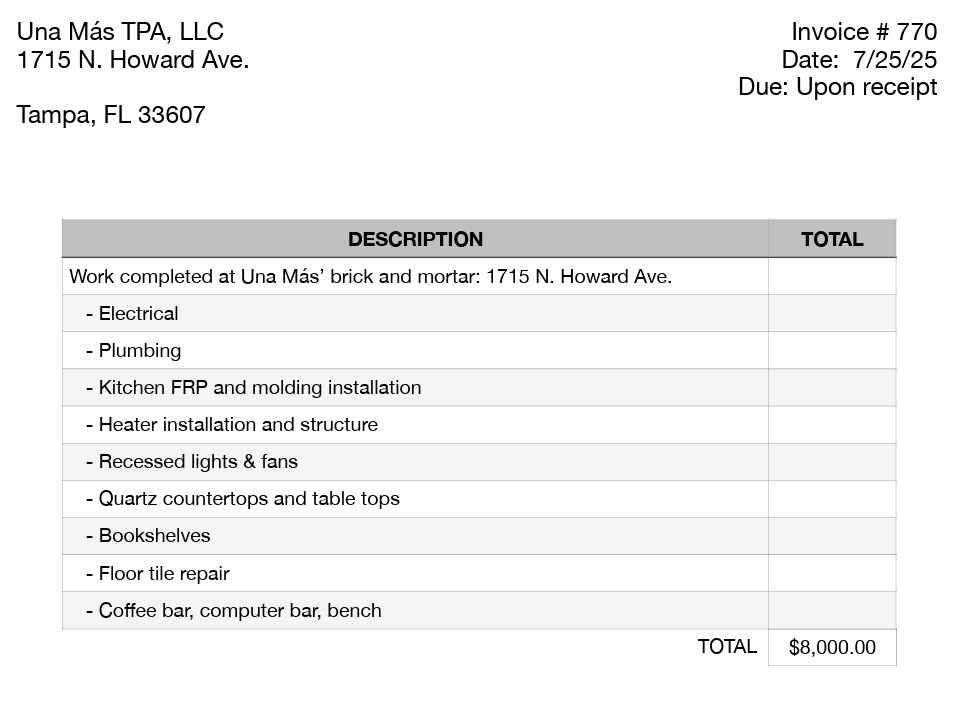
The actual invoice: $8,000 for work that included electrical, plumbing, custom countertops, and more.
So, once I offered the same terms back and they were accepted, I ended up staying with the company I'd built — a plot twist I didn't see coming, but a satisfying one. Funny how that works out sometimes.
The Paperwork
This is the part I would tell anyone to slow down for. A partnership is binding to start, but it's even more binding to end, depending on how the exit agreement is actually written.
At this point, thanks to my in-laws, I engaged a lawyer and had him review the draft before signing anything. Both sides should push to include what matters to them: for me, that meant making sure all intellectual property - recipes, brand assets, everything built under the brand - was explicitly assigned to me and the company. Recipes were especially important to me, as 100% of the signature drink items on our menu were developed by me. This was also true for the majority of the food menu, which I developed and taught others for prep and execution, specifically the hogao (the secret sauce to the burritos and bowls), the cilantro crema, the aji, the pasteles de pollo, the arepas, and the Oreo twists.
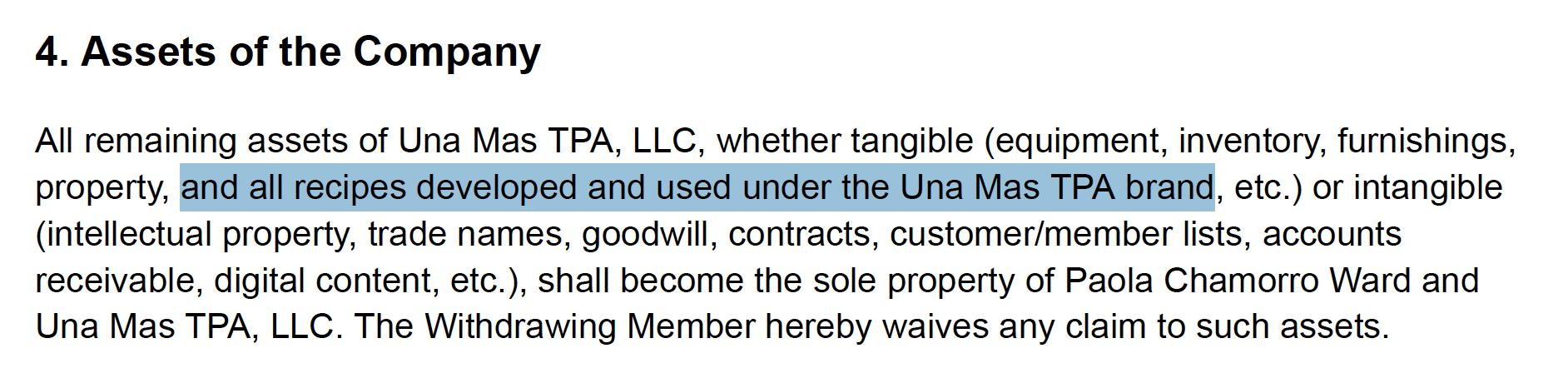
The final agreement explicitly included recipes and intellectual property among the company assets assigned to me and Una Más TPA, LLC.
The other non-negotiable, on my lawyer's advice: mutual indemnification. The first draft of the agreement only indemnified one party. For me, that protection needed to go both ways, full stop. Thanks to my lawyer, I flagged it, said I wouldn't sign without it, and it got fixed.
If you're ever the one drafting or reviewing a dissolution agreement, read every clause like it's going to be tested one day, because it might be. And this goes both ways, on the things you want to enforce on the other party, and the things the other party may try to enforce on you.
Making It Official
Negotiation is a lot of back and forth. Don't let the annoyance of the limbo pressure you to sign until you're fully clear and every question has been solved.
Once the terms were settled, we signed two copies in front of a notary at the bank, which is what I needed in order to remove him from the company's official documents. First, I had to submit a change to the State to remove him from the LLC, wait for that to show up in public records, and then go to the bank with that to remove him from the account and cancel his card.
And the official process was done.
What Doesn't Fit in a Spreadsheet
There’s also the emotional side of dissolving a partnership, which I haven’t really touched on here. I’m not going to get into the details, because they’re not relevant to the actual process of dissolving a partnership. But I will say this: after 15 years married, I had forgotten how emotionally complicated the end of a relationship could be. And when that relationship is a business partnership, there’s money, your reputation, and your business on the line.
The biggest thing I took from it: trust your gut early, know your number before you sit down, and accept that you can't control what people outside the room decide happened inside it. Time has a way of sorting that part out.
And to anyone who says “You don’t know the whole story”: you're absolutely right, you don't.
One of the harder things to admit: we were genuinely great as co-workers — easily one of the better people I’ve worked with. But I learned that being compatible as co-workers and being compatible as business partners are two completely different things, and I didn’t see that distinction clearly enough going in.
And if I'm being fully honest with myself: The 50/50 wasn’t thought out. And the harder truth is we never really discussed what 50/50 meant. I just defaulted to it when we were writing up the company's values and mission, and the foundational paperwork we did early and didn’t think twice about. We never sat down and asked whether equal ownership made sense for the partnership, or what would happen structurally the day we didn’t agree on something. That's on me. It's an easy number to reach for because it feels fair on its face, but "fair" and "thought through" aren't the same thing.
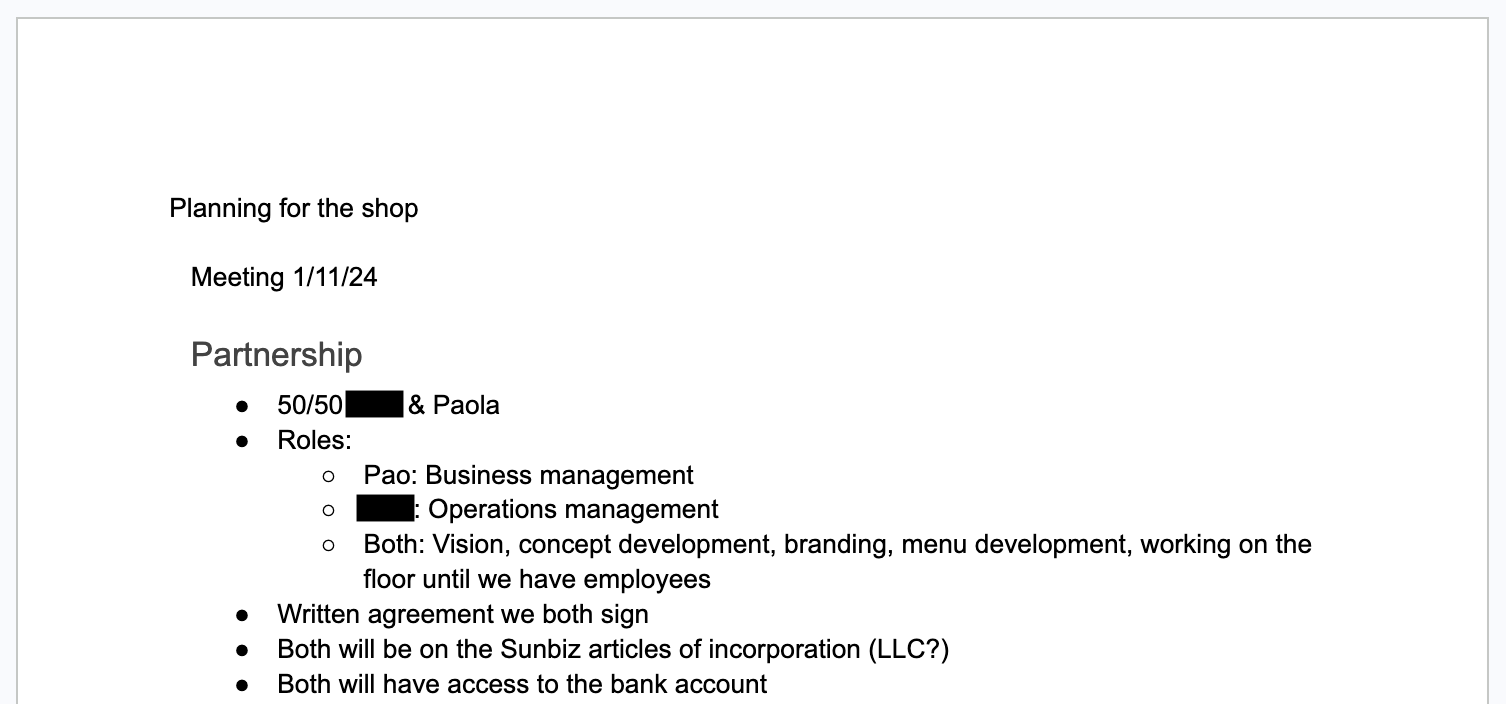
The actual document: 50/50 was one line in a planning doc, never its own conversation.
I don't plan to partner with anyone again. I believe in collaboration, in working with others, but handing over 50% of the decision-making, the creative direction, on something I'd spent years dreaming about and building toward cost me more than anything else has in this business. I got to keep the company in the end, with what mattered to me the most: the recipes, the systems, and the brand - that's mine, and it's spelled out in writing now, not just in my head. But the experience taught me how much control I had casually handed over in something I had spent years working to build.
I don’t like having a boss, and a partnership ended up being harder than that. But unlike when you have a boss, this wasn’t about taking direction. It was about being bound to someone else for decisions, execution, vision, and the future.
If you're considering a partnership, a few questions worth sitting with first:
Have you actually talked through the ownership split, or did you default to something that "feels fair" without stress-testing what happens if you don't agree?
If your exit paperwork ever went to a lawyer, what would you make sure was mutual — indemnification, liability, etc — instead of protecting just one side?
Do you know your own floor number before you're ever in a negotiation, not just your ideal outcome? Keep in mind it’s not just about a number; other factors can affect the negotiation, such as liability of debt.
Have you talked about structure, not just price? Would either of you actually offer flexibility (a payment plan, a timeline) if it came up?
If one of you wanted out tomorrow, is there any agreed process, or would you be building the whole thing from scratch?
How does each of you handle pressure and uncertainty — the parts of building a business that are just... waiting?
Have you looked into vesting or studied how other companies structure ownership, exits, and new investment?
Knowing how this ends before you start doesn't mean it will end. But it means you'll know what to do if it does. Knowledge is power.
This whole process — the inventory, the P&Ls, the valuation, the negotiation, reading the fine print before signing anything — shaped how I now help other coffee shop and cart owners think through their own numbers and decisions before they're ever in a position like this one. If any of this feels close to home, that's the kind of work I do through Café con Pao. Send me a message if you want to chat about working together.
